
Proactively supporting students through public benefits applications
This is the third pilot in our series of tests to increase student success through basic needs support.
Applying for public benefits through BenefitsCal can be a critical lifeline for students facing food, housing, or financial insecurity—and many dedicated state, county, and community partners work hard to make this support accessible. Even so, from a student’s perspective, the application process can still be difficult to navigate. The process to apply for public benefits takes longer than students often expect. Additionally, the terminology, requirements, and fear of making a mistake in completing a public benefits application can slow progress, or stop it altogether.
Rather than waiting for students to reach a point of acute need or disengage partway through the process, this pilot took a proactive approach. We tested whether introducing structured, student-centered supports early in the application journey could reduce friction, ease anxiety, and support follow-through within the existing public benefits system.
Our approach
To take a proactive approach to supporting students through the public benefits application process, we engaged students directly through interviews and real-time observations as they completed the BenefitsCal application. This allowed us to understand where in the process students experience confusion, stress, and disengagement.
Across these sessions, students consistently asked for clarification around questions about household composition, income, and expenses. Many expressed concern that a single mistake could jeopardize their eligibility. After submitting an application, students were often unsure what would happen next or how to check their status—an uncertainty that shaped how they approached the entire process.
Instead of attributing these challenges to individual circumstances, we used student feedback to inform the design of targeted supports intended to clarify expectations, reduce anxiety, and make the process feel more navigable. Based on what students told us and showed us in real time, we developed three complementary tools to support students across the application journey:
Application Checklist: A step-by-step guide that breaks the process into manageable chunks, with time estimates, instructions, and links to additional support.
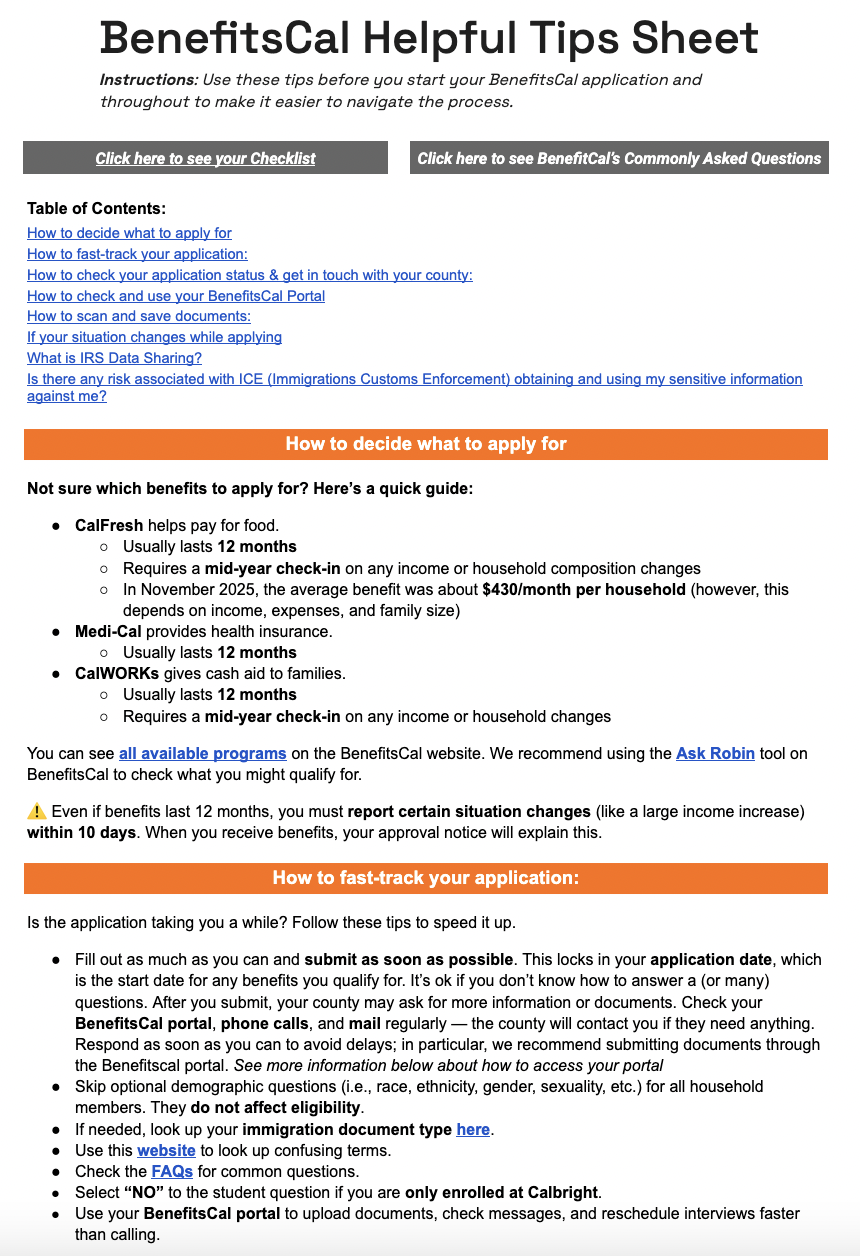
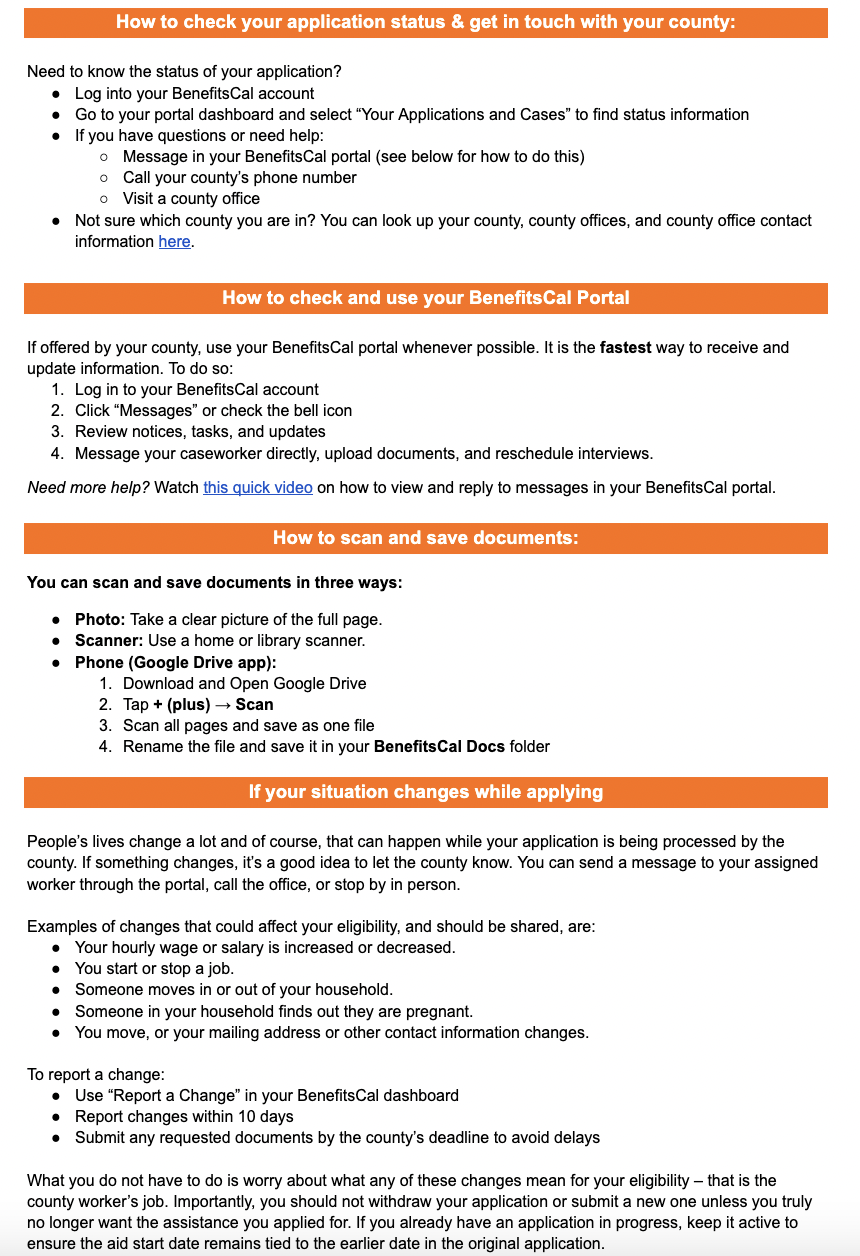
Helpful Tips Sheet: Plain-language explanations of complex terms, examples for common pain points (such as document uploads), and reassurance that applications do not need to be perfect on the first pass.
Journey Map: A high-level visual overview of the end-to-end process, showing how student actions intersect with county actions to reduce uncertainty about what happens after an application is submitted.
After multiple rounds of iteration with Calbright College and Catbird Strategies, we shared these tools with students at different stages of the application process. We gathered feedback and observed how students used the supports while applying, using these insights to further refine the tools.
The results
Student feedback revealed how small moments of clarity and reassurance can meaningfully change how students experience the public benefits application process. Many students described entering the application with uncertainty about what was coming next and whether they were completing it “correctly.” Tools that helped students anticipate steps, understand expectations, and prepare in advance reduced stress and made the process feel more manageable.
Several students gravitated toward the Application Checklist as a steady reference point throughout the process. They used it to orient themselves, confirm they were on track, and understand what would happen next.
“It really is a pretty good checklist to go by…it gives you what’s next… and [helps you] prepare in advance for what’s going to happen.”
“It’s like if your BFF knew the ins and outs of the system.”
Students also described the Helpful Tips Sheet as a practical resource they returned to over time. One student who had not previously applied for CalFresh because they assumed they were ineligible learned about BenefitsCal’s chatbot assistant, Ask Robin, through the Tips Sheet. While tools like Ask Robin cannot account for every individual circumstance, the student used it to quickly gain a clearer sense of their likely eligibility and felt more confident continuing with the application.
Other students highlighted similarly concrete benefits. One learned how to scan and upload documents directly from their phone—an administrative hurdle we consistently observed during applications. Several participants reported revisiting the Tips Sheet later in the process when they encountered unfamiliar terms or steps.
“I don’t think I would have [known to use the Ask Robin tool without the Tips Sheet]. I think Ask Robin was really helpful to tell [you] what kind of programs you’re gonna be eligible for.”
“The tips were helpful in the beginning, to know which benefits I wanted to apply for, then to confirm what I wanted, and how to fast-track the application. [The tip on] uploading documents is probably very helpful, too.”
Reactions to the Journey Map were more mixed. While some students appreciated the high-level overview early on, many did not return to it during task-focused stages. Several found the circular layout confusing and expected a more linear, step-by-step format that better matched how they think about administrative processes.
Across all interviews, one insight stood out clearly: fear of making a mistake was the dominant barrier to completion. Every student we spoke with described anxiety about answering questions incorrectly and potentially affecting their own or their family’s eligibility. This fear slowed progress and shaped how students interpreted the application. Clear guidance, and reassurance that students could describe their situation as accurately as possible in the moment, helped reduce stress and supported continued momentum.
Students know what works best for them. Engaging students throughout this pilot was critical to identifying where supports were helpful, where they fell short, and how they could be improved. As we scale our impact, we will continue to collaborate closely with students and benefits experts, and use their input to co-design new and responsive approaches that can help students better access and retain public benefits.
